

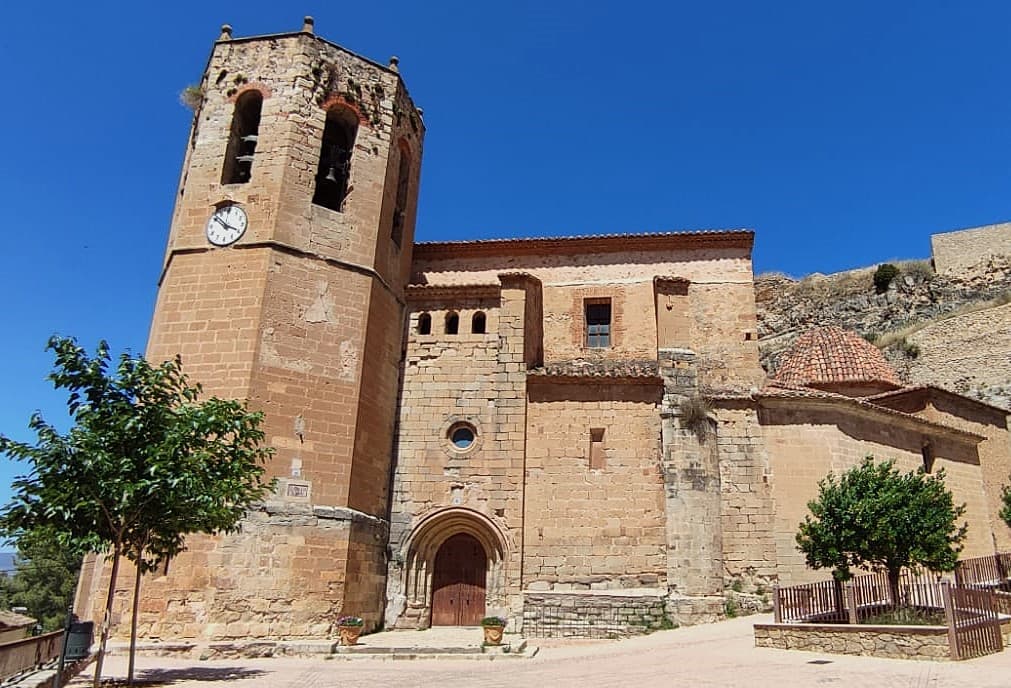
Church of Our Lady of Mercy
Discover the Church of Our Lady of Mercy: The Historic Heart of Alpuente

Discover the Church of Our Lady of Mercy: The Historic Heart of Alpuente
Travel back in time and surrender to the charm of the Church of Our Lady of Mercy, a majestic sanctuary in the historic district of Alpuente.
A Journey Through Architecture and Time
Completed in 1376, this Gothic gem will surprise you with its Romanesque influences. Let yourself be captivated by its flared façade with slightly pointed arches and its paired semicircular windows—an astonishing dialogue between two artistic eras.
Over time, two great treasures were added to its original silhouette: the majestic Choir (1499) and the intimate Chapel of the Communion (1675–1680).
The Bell Tower: Stones with Character
It’s impossible not to look up and admire its imposing octagonal bell tower. Built with sturdy, carved sandstone blocks, if you look closely, you can still see on its exterior the marks left by medieval stonemasons—authentic signatures of the artisans who erected this giant.
Stories of Faith, Mystery, and Tradition
The church is also the source of our devotional identity. In 1614, the old adjacent cemetery revealed a secret: the discovery of the Virgin of Consolation, patron saint of Alpuente. This fascinating polychrome carving with Gothic features is preserved today in the Parish Church of Corcolilla, serving as a cornerstone of our traditions.
Resilience and Rebirth
The church’s history is also a story of overcoming adversity. After being partially destroyed during the First Carlist War, it was restored in 1850 in the Neoclassical style. Although the tragic fire and looting of 1936 deprived us of its organ and some of its bells, the church still stands, imposing, as a witness to the centuries, having belonged to the Diocese of Segorbe until 1963.