

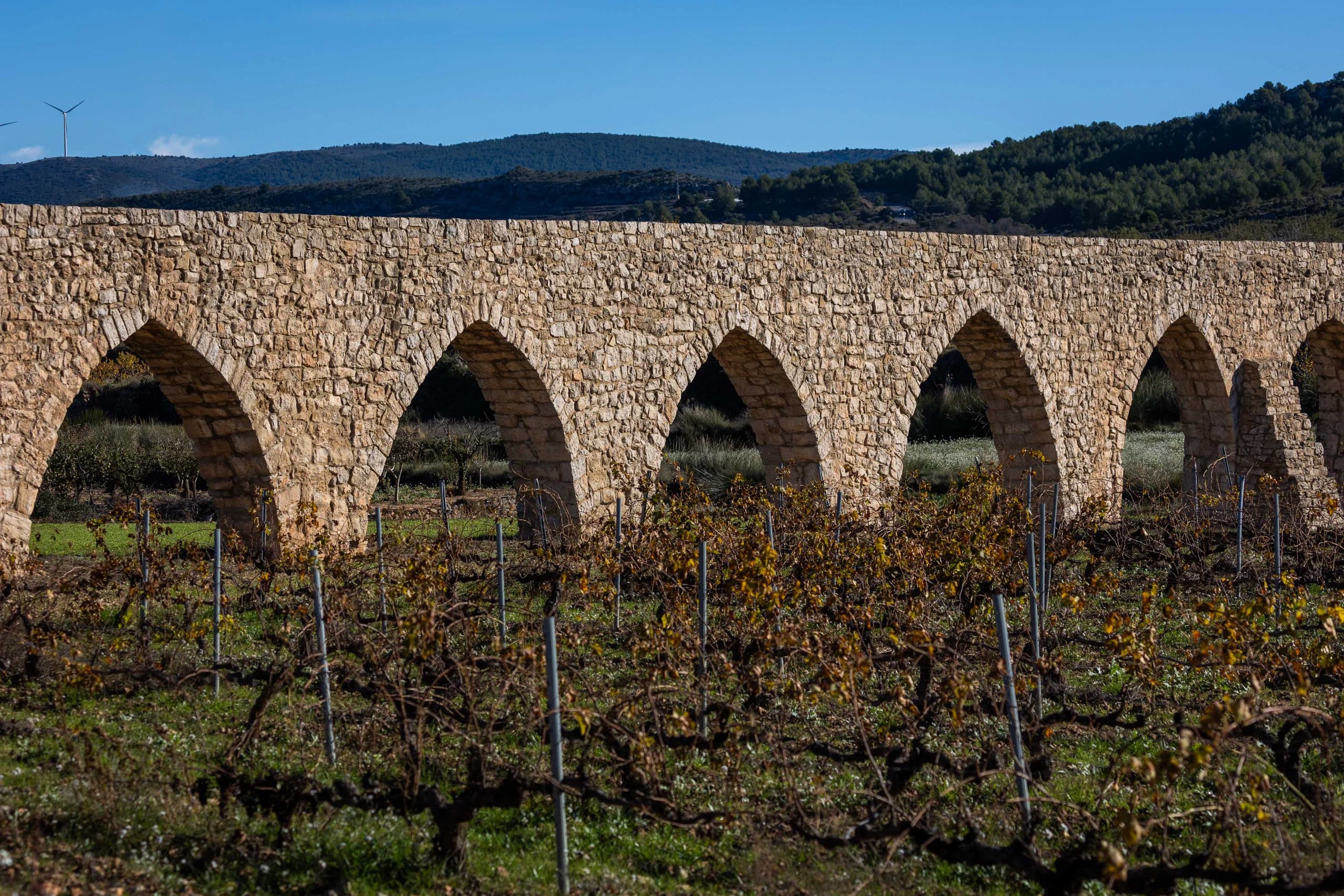
Medieval Aqueduct of Los Arcos
The Los Arcos Aqueduct: A Medieval Monument in Alpuente

The Los Arcos Aqueduct: A Medieval Monument in Alpuente
Get ready to be left breathless by the Los Arcos Aqueduct, a spectacular hydraulic structure built between the 16th and 17th centuries. This impressive work of medieval art and engineering was built for a vital purpose: to channel water from the Fuentes Nueva and Marimacho springs to provide irrigation, drinking water, and sustenance for the orchards and washing areas of the town of Alpuente.
Due to its spectacular nature and historical value, it was designated a Site of Cultural Interest (BIC) in 2005.
The Three Pieces of a Perfect Mechanism
Los Arcos is not an isolated monument, but rather part of a larger hydraulic system composed of three elements:
The Intake: The source from which the waters of the Nueva and Marimacho springs originated.
The Main Canal: A canal dug directly into the ground. It channels the water for 230 meters to the aqueduct and, from there, winds for 3 kilometers, following the mountain’s contour lines until it reaches the town.
The Arches: The monumental aqueduct that rises majestically to span the steep drop over the Reguero River.
Characteristics of a Great Engineering Feat
With a length of 265 meters along a nearly straight path (except for a slight curve 14 meters from its starting point), its archwork is a visual spectacle:
It consists of thirteen pointed arches arranged in a regular pattern.
Ten of them are similar, of the lowered type, and are located on the right bank of the river, facing south.
A History of Strength and Reconstruction
Like any great structure, Los Arcos bears its own epic scars. Did you know that the main arch—the one that spanned the river—disappeared? It was the most imposing of them all, but a devastating flood in 1880 swept it away, also damaging the neighboring arches.
Demonstrating the resilience of our region, between 1986 and 1988 the aqueduct was restored through a project that incorporated two concrete arches, preserving the original silhouette and blending medieval history with modern engineering.