

Route of the Subdistricts
Along this route, you’ll discover the surrounding villages that make up the municipality of Sepúlveda and all the beauty and rich heritage they have to offer.

On this route, you’ll discover the outlying villages that make up the municipality of Sepúlveda and all the beauty and rich heritage they have to offer.
1. DURATÓN
Duratón, located about 7 km upstream from Sepúlveda, takes its name from the river that flows through its territory, and apparently means “Little Duero.”
Duratón’s immense archaeological and architectural heritage indicates that it has been inhabited since ancient times, with particular significance during the Roman and Visigothic periods. The three most significant sites within its municipal boundaries are the Roman city, the Visigothic necropolis, and the Romanesque church of Nuestra Señora de la Asunción.
As for the Roman city, it has been identified as the “Confloenta” mentioned in classical texts, pending epigraphic confirmation. It is believed to have been a city built from scratch on a plain atop the Duratón river terrace, featuring a regular urban layout. Currently, this site is undergoing a fruitful period of research, with some parts of the city having been located, documented, studied, and even excavated, such as the Southern and Central Baths, an access ramp, the Livestock Forum, the Municipal Forum, and elements of domestic architecture, with the discovery of various mosaics and other remains of great archaeological importance. From its founding in the early 1st century B.C., it administered the territory stretching from the upper Cega Valley to the upper Duratón Valley, with the 2nd century A.D. the period of greatest splendor and development for this city, which continued to function throughout the High Imperial period and remained occupied into Late Antiquity. This site is expected to be prepared for visitors in the near future.
The Visigothic necropolis consists of 666 burials, dating from the last third of the 5th century to the 6th century A.D., and is possibly the most notable Late Antique cemetery documented in Hispania. High-quality grave goods were found in numerous burials, consisting of fibulae, belt buckles, and other goldsmithing pieces made of silver, iron, bronze, and glass paste, which are now part of the Segovia Museum’s collection.
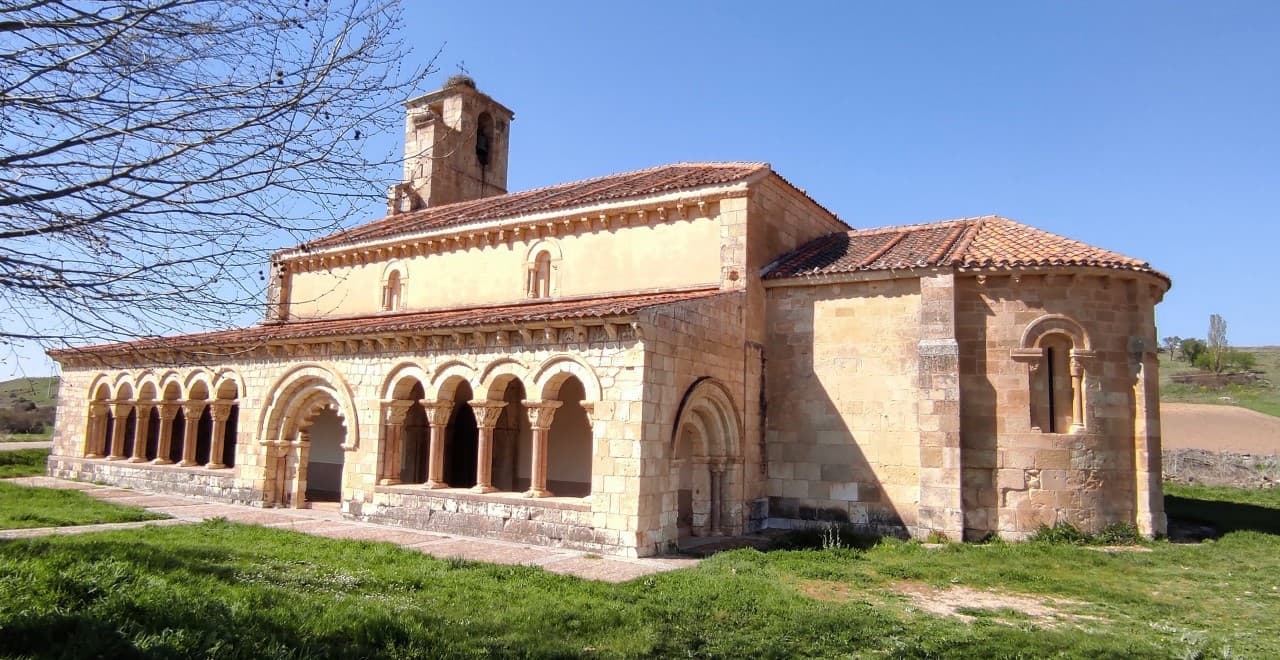
Between the late 12th and 13th centuries, the Church of Our Lady of the Assumption—one of the most splendid examples of rural Romanesque architecture in Segovia—was built over part of the Visigothic necropolis. With a basilica-style floor plan and modest dimensions, the church is notable for the unity of its design, the elegance of its architectural forms, and the delicacy of its sculpture. The porticoed gallery consists of two sections separated by an entrance door featuring a richly decorated structure with three archivolts, and the double columns supporting the arches feature a series of magnificently crafted capitals, depicting scenes such as the Incarnation, the Visitation, the Nativity, the Adoration of the Shepherds, and the Epiphany of the Magi. The sculptural beauty continues along the gallery’s cornice with an extensive set of corbels and metopes
Inside, the beauty of the chancel is striking, with a layout far more complex than usual. The triumphal arch is slightly pointed, and the presbytery is covered by a ribbed vault supported by columns, while the apse is covered by a barrel vault with reinforcing ribs. In the apse, the columns flanking the three large windows support the vault’s ribs and feature a rich and easily recognizable repertoire of sculptures, such as Susanna and the Elders, Daniel among the lions, Samson tearing the lion apart, and the Epiphany.
This rich heritage also includes the San Isidro Chapel in the town center, several houses bearing coats of arms, and the Azo Fountain.