
Sepúlveda's Charter
Sepúlveda's charters are notable for their historical significance. The city had two: the Short Charter (1076) and the Long Charter (1305).

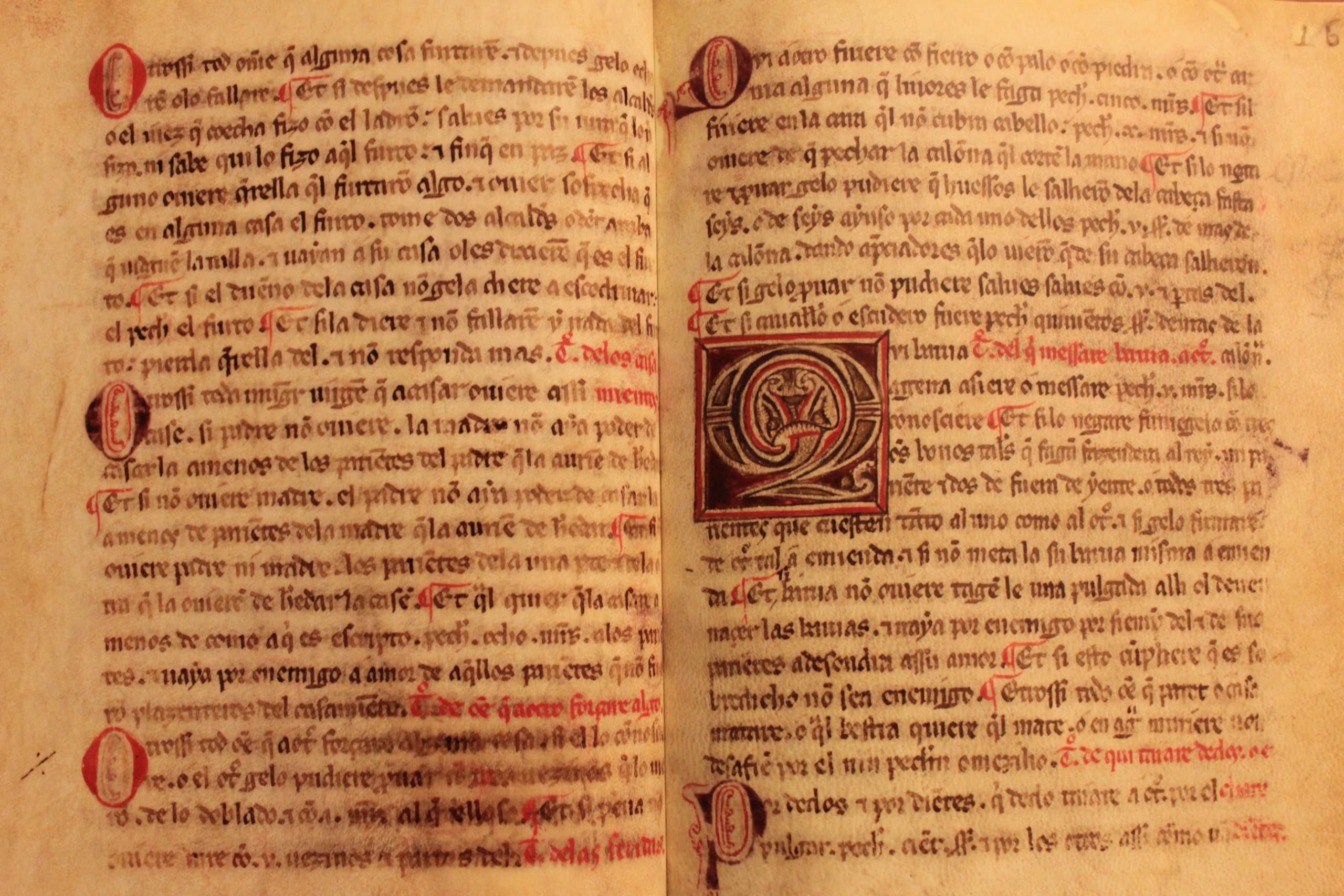
Fernán González granted the settlers of Sepúlveda the Fuero and assigned them a municipal district, the alfoz, which has survived to this day as the Comunidad de Villa y Tierra. However, the first text we possess is the one confirmed by Alfonso VI, the Fuero Breve or Latino.
In the High Middle Ages, Sepúlveda was a frontier land. To encourage the repopulation and defense of reconquered areas where lives were at risk, monarchs granted its inhabitants privileges so significant and novel that, over time, they came to articulate a legal (the Fueros de Sepúlveda) and political-administrative model (the Concejo Extremadura), characterized by its high level of self-management.
The Fuero de Sepúlveda, granted by Alfonso VI in 1076, was the first frontier charter in which a new repopulation model was embodied. It offered numerous economic, civil, political-administrative, and penal privileges, tax exemptions, etc. Such a concession aimed to call upon all those subject to ties of economic or personal seigneurial dependence to join in the reconquest and repopulation of the frontier zones. We can identify two administrative models of medieval Castilian municipal charters: a first interventionist model and a second self-normative model, born in Sepúlveda and extended throughout the frontier lands of the Extremadura Castellana (at the ends of the Duero), characterized by the capacity for self-government granted to the Concejo, which annually appointed its judges and mayors. In this latter charter model, the representative designated by the King or the Count to defend their interests in the town sees their influence on municipal life greatly limited. That is to say, with the Fuero, the King renounced the right to appoint the highest authority of the town, the judge, agreeing that it be a popular annual election by all the inhabitants of the Concejo. He also accepted that the other municipal positions be designated from among the residents of the town and not from outside. The Fuero de Sepúlveda soon acquired fame for its extraordinarily privileged content, extending as far as Uclés, Roa, Segura de León, Teruel, Santa María de Albarracín or Morella, among others.
The text of the Fuero Breve, also called the Fuero Latino because it is written in that language, contains the confirmation made on November 17, 1076, by Alfonso VI, known as “El Bravo”, and Inés, his wife, of privileges that had already been granted previously to the town of Sepúlveda by the Castilian counts Fernán González (930-970), García Fernández (970-995), and Sancho García (995-1017), and by King Sancho III of Navarre, called “El Mayor” or “El Grande”, grandfather of Alfonso VI.
The Fuero Extenso, also known as the Fuero Romanceado because it is written in old Castilian, is also of great importance as it is not a copy of the previous one but the original document.
In the Castile of the upper Duero during the 11th and 12th centuries, in frontier cities with a vast territory to populate, such as Sepúlveda, the Comunidades de Villa y Tierra were created. Their origin lies in the repopulation by large urban councils, which organized rural councils, dependent upon them, for the regulation of the “commons”, that is, pastures, forests, water, livestock, etc. Sepúlveda adopted this formula and created the Comunidad de Villa y Tierra de Sepúlveda. However, no documents remain that tell us of the creation or authorization for the Comunidad de Villa y Tierra. Perhaps there was no specific date of creation, but rather it formed over the years, although it was at the end of the 11th century, with the definitive repopulation by Alfonso VI, that it must have formed spontaneously. The Comunidad de Villa y Tierra de Sepúlveda is composed of the town, the head of the Community, and the villages or Tierra, all under a common regime that exercises its power over the territory and the population, and which is manifested through the Concejo, as a governing body, and legal norms. During the Sepúlveda repopulation, the districts were divided into ochavos. At the head of these was an official, called an ochavero, in charge of directing the repopulation and acting as a representative of their villages before the town.
The Comunidad de Villa y Tierra de Sepúlveda continues to exist today and manages and defends its heritage, both urban and rural. Likewise, it manages common services, such as water supply, road cleaning, fire prevention, etc. Currently, it is composed of six ochavos: Sepúlveda, Cantalejo, Prádena, las Pedrizas y Valdenavares, de la Sierra y Castillejo, and de Bercimuel.