

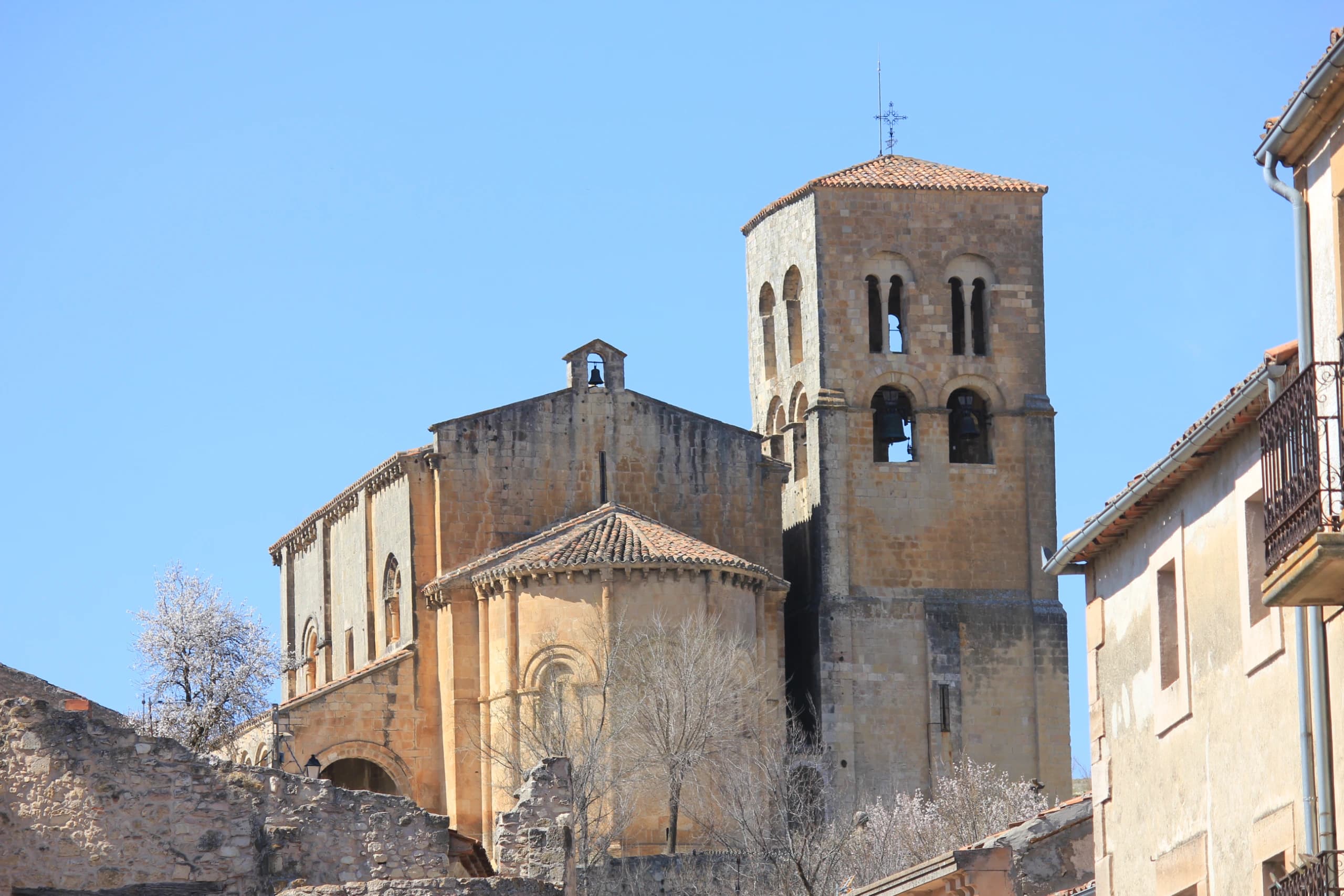
The Churches of Sepúlveda
The Romanesque churches of El Salvador, Our Lady of La Peña, St. Bartholomew, St. James, and Saints Justus and Pastor are landmarks not only in the province’s Romanesque architecture but also on a national scale. Visitin

Church of El Salvador
Designated a Site of Cultural Interest, it is considered the oldest Romanesque building (11th century—1093) in the province of Segovia and south of the Duero River, and stands as one of the prime examples of Castilian Romanesque architecture.
It has a single nave with a semicircular apse; its tower stands separate from the nave and is accessed via a narrow vaulted passageway. The nave, covered by a barrel vault, is divided into three bays by transverse arches supported by pilasters.
Attached to the walls are blind arcades supported by columns. Their height exceeds what is typical for this style. The tower has a double row of openings, and its upper floor is covered by a Muslim-style barrel vault. The arches of the portico are grouped in pairs, each resting separately on wide pilasters and, where they meet, on shared columns. A ashlar in the apse bears the date 1093. The portico is somewhat later.
The architectural mastery of this church is impressive. We are looking at a work of art, an example of early Romanesque architecture in Segovia and, perhaps, in Castile, in this part of the region south of the Duero River.
It appears that the builder of this parish church was a foreign artist, perhaps a Benedictine monk from Silos who was working on the Way of St. James and was very familiar with the Romanesque style.
The most characteristic features of this church are the harmony of its proportions, along with the height and perfection of its vault. The transverse arch is a double semicircular arch with moldings of trefoil leaves. A stepped impost runs along it from the base of the vault, joining the vault’s moldings via the transverse arch.
The geometric and vegetal motifs (featuring acanthus leaves, pine cones, grapevines, palmettes, undulating stems, circular flowers, etc.) follow Asturian (six-pointed stars), Mozarabic, and, above all, Visigothic models. A notable feature is the Irish knots, which abound on the capitals of the blind arches in the nave. One capital in the tower is carved with a horseshoe arch, a replica of one found in the Cave of the Seven Altars. Human and animal heads and figures—both those common to the region and imaginary, ferocious ones—abound on the corbels.
The portico faces south and features eight arches supported by smooth rectangular columns. The capitals feature various motifs: four-legged creatures with monster heads, large leaves with bulbs… A curiosity still visible today are the marks or signatures of the stonemasons, which highlight the importance of this guild among the population since the Middle Ages.
One of the traditions held in this unique building takes place every third Sunday of the month and is called the “Mass of Minerva,” established to honor the Blessed Sacrament in all its splendor. The Mass is celebrated in this church with the participation of the members of the ancient Brotherhood of the Lord. After the Mass, there is a procession of the Blessed Sacrament that winds through the cloister. The lit candles, the roll of the ancient drum, and the scent of incense are some of the distinctive elements of this tradition.
The original church of Our Lady of La Peña, a 12th-century Romanesque structure, is complemented by the chapel, the sacristy, the portico (which was added in the 13th century but is also Romanesque), the porticoed gallery on the right side, and the priest’s house at the foot of the church.
The church has a single nave structured by the supports of the transverse arches that divide it into four sections with barrel vaults. The main nave is notably wider and taller than the apse. The apse is almost identical to that of El Salvador, with attached columns, ogee arches in its openings, and a checkered molding that runs the entire length of the semicircle. The vault is a half-barrel stone vault, with blind arches on either side, over which runs the