

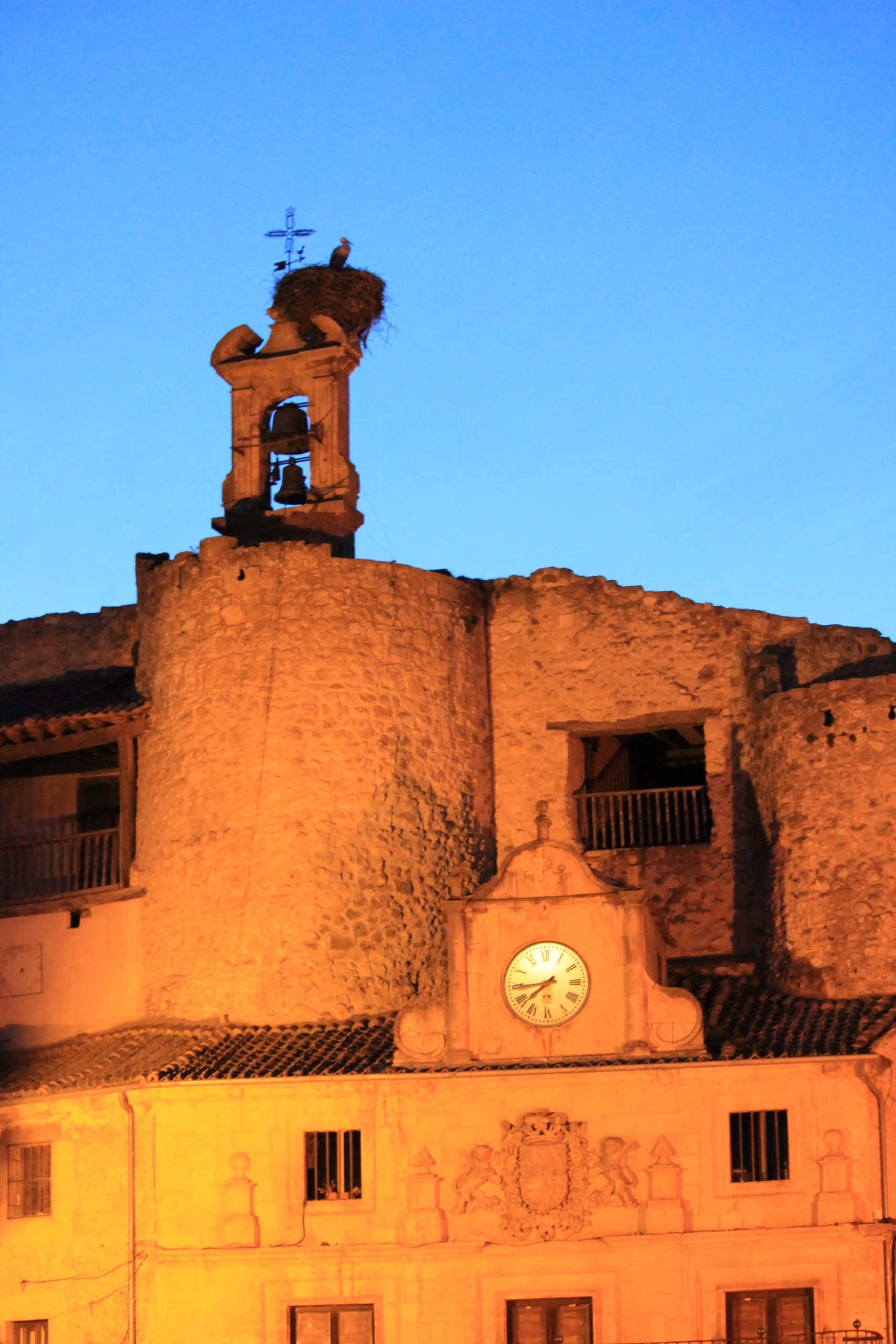
Clock Tower and City Wall
The building known as the castle marks the boundary of the town’s walls and forms one of the shorter sides of the Plaza Mayor (which is rectangular and partially colonnaded). Seven gates of the city wall remain today, wh

The building known as the castle marks the boundary of the town’s walls and forms one of the shorter sides of the Plaza Mayor (a rectangular, partially arcaded square).
The building is the result of three very distinct periods: first, there are three towers belonging to the 10th-century Moorish wall, which was also part of the castle-palace; second, in the sections of the wall, there are two balconies belonging to the house of the González de Sepúlveda family, a 16th-century building whose walls witnessed the birth of the well-known writer Don Francisco de Cossío; in the 18th century, a Baroque façade was added to the castle, accompanied by a belfry located in the central tower and housing two bells, one of which, the “zángana,” rings the traditional “Toque de Queda” every day—33 chimes that once announced the closing of the city gates and are now part of the town’s intangible cultural heritage.
This building, which once served as the town hall, but which is best known as “El Registro” (The Registry)—since it was the place where raw materials brought to Sepúlveda for sale were registered and where taxes were paid—houses the balcony from which the authorities presided over public ceremonies. Today, the castle hosts cultural exhibitions, and from its balcony the “chupinazo”—the signal announcing the start of the Fiestas de los Toros—is launched.
It is possible to trace the course of the city wall in some areas, such as the section known as Trascastillo and the El Postiguillo area. Some of its Seven Gates have also been preserved: at the entrance to the street leading to the Shrine of Our Lady of the Virgin of La Peña stands the gate known as the Puerta del Azogue or the Puerta del Ecce Homo; on the outskirts, on the way to the Hoces del Río Duratón Natural Park, you can see the remains of the Puerta de la Fuerza, from which a Roman road branches off and leads to the Picazos Bridge; and in the San Esteban neighborhood stands the Puerta del Río, next to the niche dedicated to the Virgin of Las Pucherillas.