

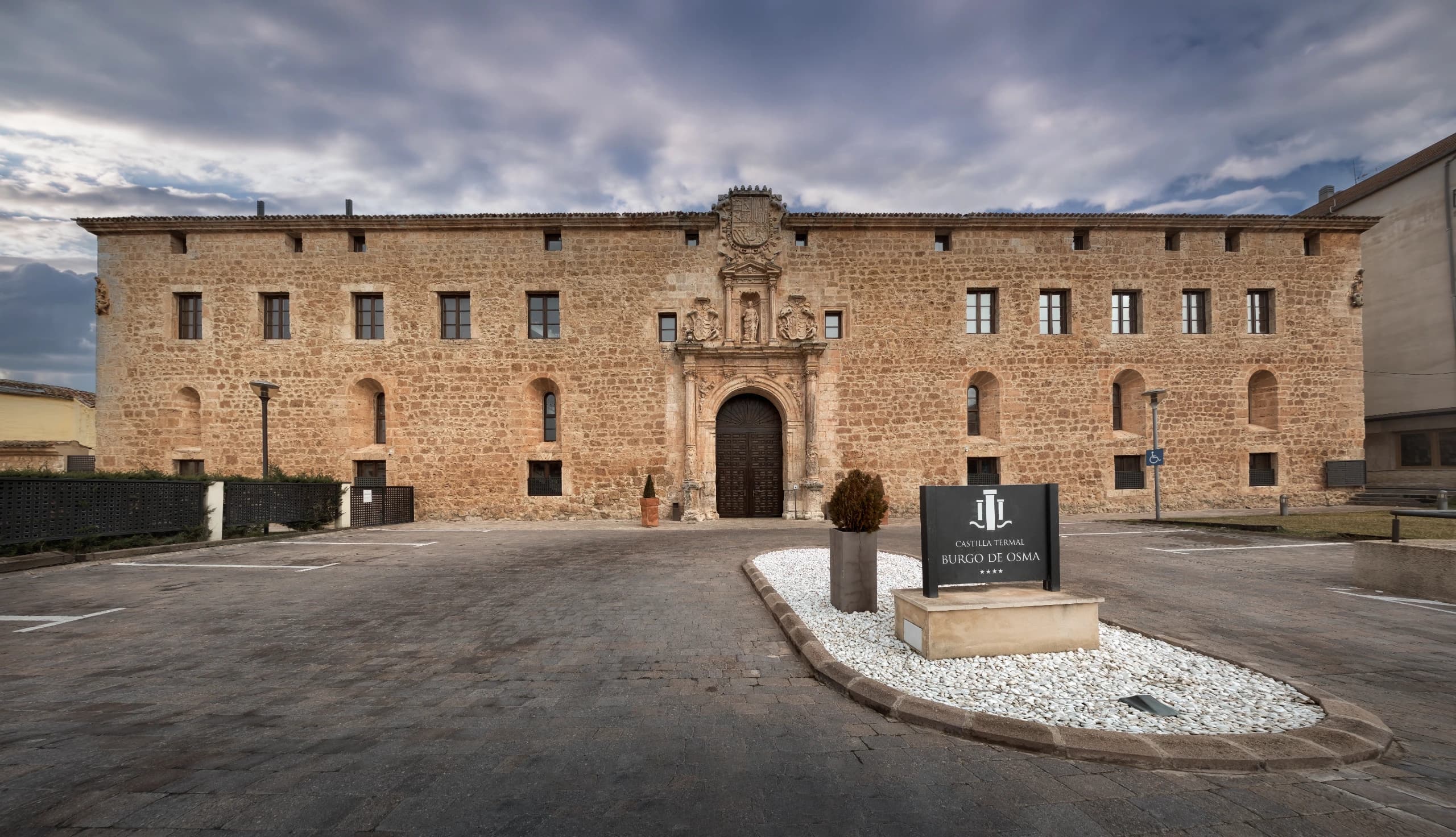
Former University of Santa Catalina
The former University of Santa Catalina was funded in the mid-16th century by Bishop Álvarez de Acosta (1539–63). It is a square building with sides measuring 53 meters, featuring unmistakable elements of the purist Rena

Former University of Santa Catalina
18th century
The former University of Santa Catalina was funded in the mid-16th century by Bishop Álvarez de Acosta (1539–63). It is a square building with sides measuring 53 meters, displaying unmistakable features of the purist Renaissance style.
The façade features a semicircular arch with a coffered intrados, set between attached columns. The spandrels feature reliefs of wise elders, an allegorical iconography well suited to a university building. Above the arch, a niche houses a sculpture of Saint Catherine, patron saint of philosophers and a member of a family from which Bishop Acosta was considered to be descended. On either side are the coats of arms of the donating prelate, featuring Saint Catherine’s wheel and ribs, signifying that he carried out his works “at the cost of his own ribs.”
The central courtyard is framed by a two-story colonnade; the lower level consists of semicircular arches, and the upper level of ogee arches. The monumental staircase leading to the main floor, like the courtyard itself, reflects this building’s harmony with the dominant aesthetic and architectural trends of the era. The Acosta coats of arms appear once again on the balustrade and parapet.
The papal bull founding the College-University dates from 1550. It housed faculties of Theology, Philosophy, Law, and Medicine. Academic programs were suspended in 1770 but resumed in 1778. Due to the War of Independence, it was closed again, resuming operations in 1814 only to be permanently shut down as a university in 1841 when the institution was relocated to Soria, where it did not survive. It later served as a secondary school and hosted university summer courses. The building has since been renovated and converted into a spa hotel.