

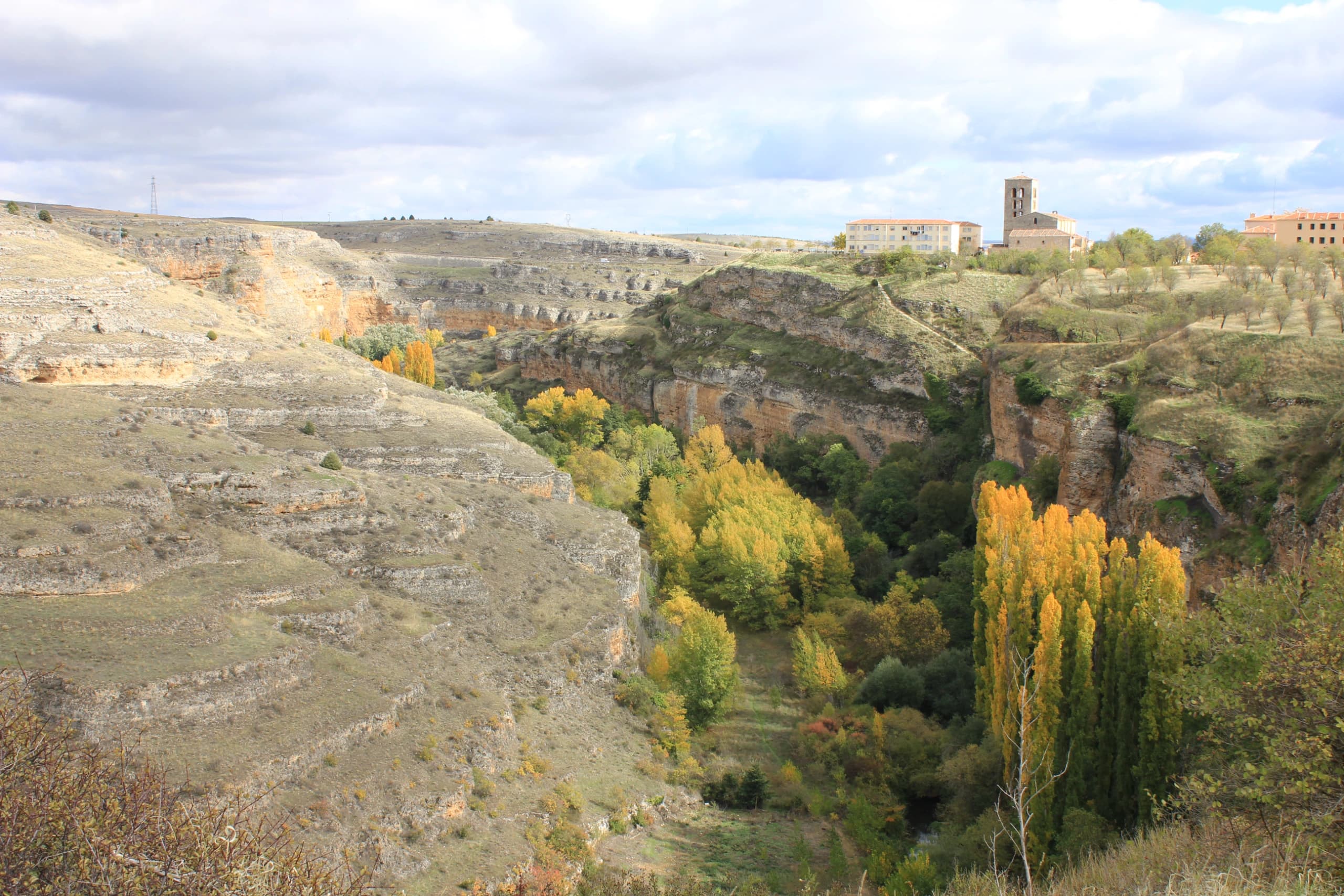
Las Hoces del Río Duratón Natural Park
Sepúlveda It’s all about art, culture, history, gastronomy, and nature. The natural setting in which it stands makes this town truly unique. As the gateway to the Hoces del Río Duratón Natural Park, viewing the first gor

This area, comprising the middle reaches of the Duratón River, was designated a Natural Park on June 27, 1989, by the Regional Parliament of Castile and León, becoming part of that region’s network of protected areas—a designation made in recognition of the importance of its natural ecosystems and scenic values. The griffon vulture colony established in the protected area is considered the largest in Europe, both in terms of its size—710 pairs were counted in 2015—and its reproductive success. This colony has become one of the park’s main attractions.
The Hoces del Río Duratón were classified as a Special Protection Area for Birds (SPA) and incorporated into the Natura 2000 Network in April 1991; they were designated a Site of Community Importance (SCI) in January 1998. Since 2004, the park has been managed through the LIFE Project, a specific action program of the European Union, under which various maintenance and restoration efforts are carried out, along with initiatives to ensure the sustainable development of the park’s resources.
The park covers an area of 5,037 hectares that extends across land in the municipalities of Sepúlveda, Sebúlcor, and Carrascal del Río, all in the province of Segovia. Along with its natural wealth, the park boasts a significant cultural heritage, making it an important tourist and recreational destination. Notable sites include the San Frutos Chapel and the Monastery of Nuestra Señora de la Hoz.
Description
The Hoces del Río Duratón Natural Park is located in northeastern Segovia, downstream from the town of Sepúlveda. In this area, the river has carved its way through a deep canyon, which in some places reaches a vertical drop of more than 100 meters.
In addition to the landscape’s beauty and appeal, the gorge also harbors a wealth of archaeological and historical treasures.
The Duratón River flows for 27 kilometers through the canyon it has carved into the limestone bedrock. In the final third of this stretch, it forms tight meanders that further highlight the depth of the canyon itself. The walls, which reach heights of 100 meters in some places, serve as nesting sites for many bird species, but the most significant are the griffon vultures, which have become one of the park’s main attractions.
The topographical features of this protected area allow for the distinction of three different environments or biotopes. The upper section is occupied by the moorland, where forests of juniper and savin trees abound but have been severely affected by human activity. There are also stands of Spanish pine growing on sandy soil. The canyon floor—with the exception of the area flooded by the reservoir—is occupied by a riparian forest composed of willows, poplars, and alders, among other species. The walls of the rocky cliffs support rupicolous vegetation—native to the rock—adapted to the scarcity of soil and water. These three distinct environments are home to a rich fauna, with birds playing a particularly significant role.
On the high rocky cliffs that crown the gorges, nearly 700 pairs of griffon vultures nest, alongside a large number of Egyptian vultures, golden eagles, and peregrine falcons.
Cultural
Heritage
The area’s natural values are further enhanced by the historical and artistic significance of the Romanesque chapel of San Frutos, the monastery of Nuestra Señora de los Ángeles at the bottom of the canyon, and the Cave of the Seven Altars.
The San Frutos Chapel
The easiest hiking route through the Hoces del Duratón begins at the dirt clearing where the Villaseca trail ends. From there, head toward the rocky spur—surrounded by cliffs—on which the San Frutos Chapel stands. After crossing a deep crevice called “La Cuchillada” via a stone bridge, you’ll ascend to the former Benedictine monastery. According to tradition, “La Cuchillada” was cleaved open by Saint Frutos with his staff to halt the Saracens and protect the residents of Sepúlveda who were calling for help; thus, the crevice marks the “sacred” ground that the infidels were forbidden to set foot upon.
Perched
on a ledge above the cliff stands the hermitage of San Frutos—actually, the Priory of San Frutos—a 12th-century Romanesque structure built atop an earlier 7th-century Visigothic building. Its founding is attributed to Saint Frutos and his