

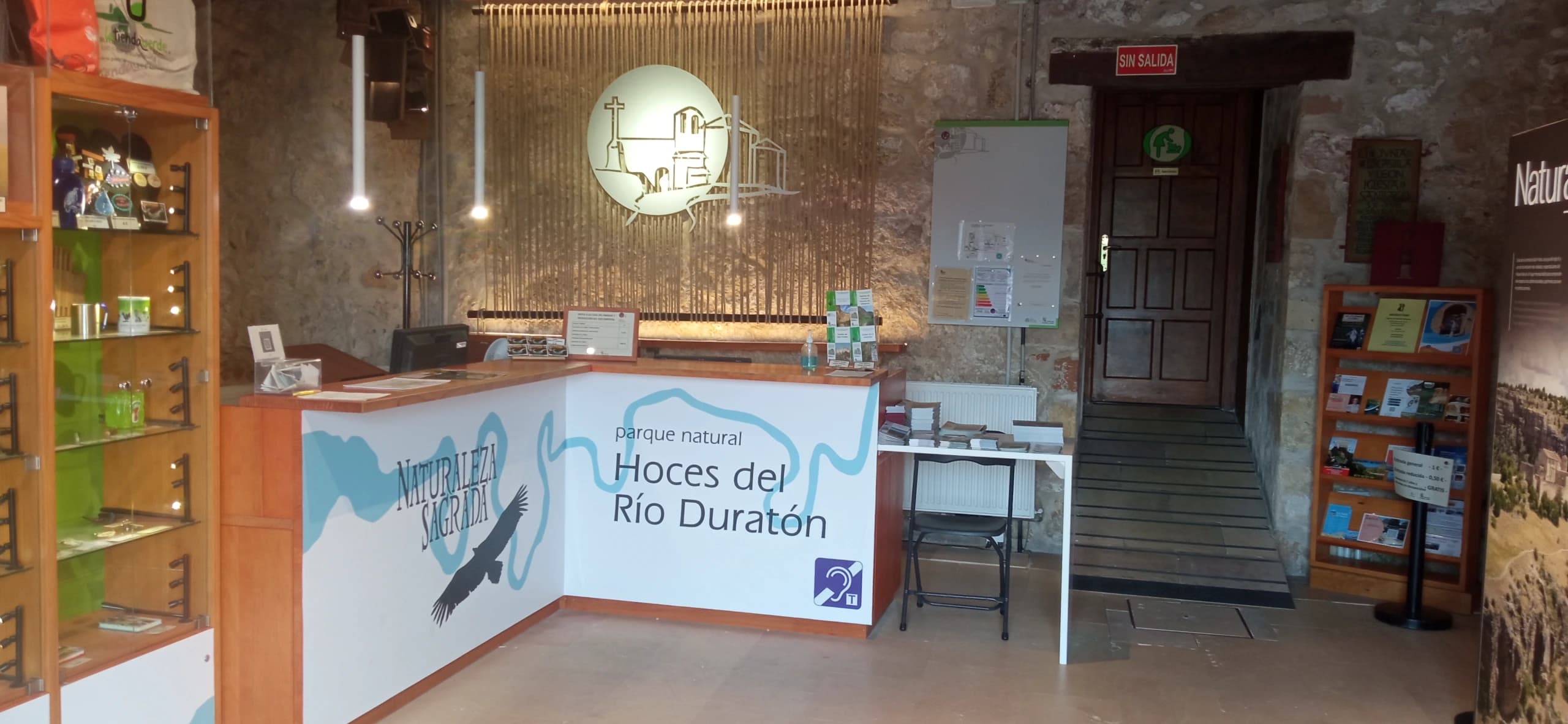
Las Hoces del Río Duratón Park Visitor Center
The Park Visitor Center, or Hoces del Río Duratón Interpretive Center, is located in the town of Sepúlveda, within its historic district, in the Church of Santiago.

The Hoces del Río Duratón Park House or Interpretation Center is located in the town of Sepúlveda, within its historic center, in the Church of Santiago.
To house the facilities of the Hoces del Río Duratón Natural Park Visitor Center, the Romanesque Church of Santiago—which had been in ruins since the 1930s—was restored in 1992. Work to prepare the facilities was completed with the inauguration and opening to the public on July 13, 1994.
The Park Visitor Center—a must-see before entering the park—consists of two environmental interpretation elements: the exhibition and the audiovisual presentation.
Reception and Welcome
The visitor reception area is located at the entrance to the Park Visitor Center. It features three information desks where specialized staff provide all kinds of information regarding the Natural Area: maps, trails, permit processing, and more.
In this area, there is also a bulletin board displaying the Park Office’s own activities, other initiatives in the region, and information of interest to both visitors and the local community within the Natural Area.
There is also a display panel featuring a sequence of photos illustrating the transformation of the ruins of the old church into the current Park Visitor Center. Next, as an introduction to the Natural Area, there is a map of the Regional Environmental Network (R.E.N.) of Castile and León and an aerial photo of the Natural Park showing its boundaries and trails. Next to this photo are maps providing information on the Natural Area’s zoning (reserve zones, limited-use zones, and compatible-use zones), the municipalities that comprise it, and the access roads.
Explore the Park: Riverbed Area
Next, visitors are immersed in an exciting adventure where they will discover the secret behind the formation of this extraordinary landscape, the flora and fauna of each of the ecosystems that make it up, and the traces left by human activity and history.
The exhibition is designed to take visitors on an imaginary walk through the Duratón Canyon. The panels are arranged to reflect the different zones found in the natural environment.
A beautiful image of the riparian forest in autumn leads us to the “wettest” part of the exhibition. The panels are arranged horizontally at mid-height, mimicking the river floodplain. A young otter serves as a special guide, describing the main characteristics of this area. The availability of water and favorable climatic conditions—thanks to the protection provided by the canyon walls—determine the presence of animal and plant species that differ from those in the surrounding areas. Visitors can observe samples of leaves from trees typical of the riverbank: poplars, alders, ash trees, willows… They can also hear the songs of birds nesting in their branches: wren, nightingale, golden oriole…
Explore the Park: Escarpment and Cliffs Area
Tall vertical panels rise majestically from the ground to reveal the main characteristics of this inhospitable place. The first panels reveal the process by which the canyon was formed and how the river’s slow, steady work has sculpted these impressive walls over millions of years, reaching heights of up to 100 meters in some areas. Through a graphic that gradually lights up, visitors can visualize the different stages of the karstification or carbonation process—a chemical reaction that explains the river’s erosive action.
As examples of rock erosion, a panoramic photo of San Frutos takes center stage here, along with a replica of the Cave of the Seven Altars (inside which we can see man-carved altars from the Visigothic period).
Next, still on the vertical walls of the canyon, is the area dedicated to the park’s most iconic bird: the griffon vulture. This section details some of the species’ main characteristics: reproductive cycle, weight, wingspan, diet, and adaptations. In the