


Mulhacén: a guide and history of the great summit of Sierra Nevada
In the heart of Sierra Nevada, between the regions of the Alpujarra and the Marquesado del Zenete, rises the Mulhacén, the highest peak on the Iberian Peninsula. Its silhouette dominates the landscape of Granada and, from its slopes, the mountain seems to change its character with every step: below appear ravines, irrigation channels, and white villages; above, a world of rock, open sky, and immense horizons.
The Mulhacén is much more than a summit. It is a place of exceptional nature, a goal for those who hike in the high mountains, and a mountain whose name keeps alive the memory of the final period of the Nasrid Kingdom of Granada.
A mountain between history and legend
The name Mulhacén is linked to Muley Hacén —also known as Mulay Hasan or Abu’l-Hasan Ali—, a 15th-century Nasrid sultan and father of Boabdil. His reign took place during a time of political and family conflict, in the final years of the Nasrid Kingdom of Granada.
Popular tradition says that Muley Hacén asked to be buried on the highest peak of his domains and that the mountain's name comes from this story. However, the burial on the Mulhacén belongs to legend: no evidence has been found to confirm that his remains rest on the summit. Historical sources place his death in 1485, but the association between the sultan and the mountain has endured for centuries and is part of the collective imagination of Sierra Nevada. Barceló Experiences recounts the history of the monarch and the tradition related to his burial.
Thus, the Mulhacén unites two distinct narratives: that of a real sovereign, linked to the history of Granada, and that of a legend that turned the mountain into a place of rest and memory. When contemplating the summit from the Alpujarra, it is easy to understand why such a tradition could take root: from up there, the territory seems to stretch out like an entire kingdom.
Where it is and what makes it special
The Mulhacén is part of Sierra Nevada, in the province of Granada, and is located within the protected area of the Sierra Nevada National Park. With 3,479 meters of altitude according to commonly cited cartography, it is the highest peak on the Iberian Peninsula. Some publications offer a slightly different figure, of 3,482 meters; that is why it is advisable to indicate the source when publishing the altitude. Trek Sierra Nevada.
The mountain presents very different slopes. The southern side is wide and gentle, and concentrates some of the best-known hiking routes. The northern face, more rugged, has an alpine character and may require mountaineering knowledge and equipment, especially when there is snow or ice. Therefore, just because a route does not require climbing in summer conditions does not mean it is simple: the altitude, the elevation gain, the hiking time, and the weather can make it a demanding activity.
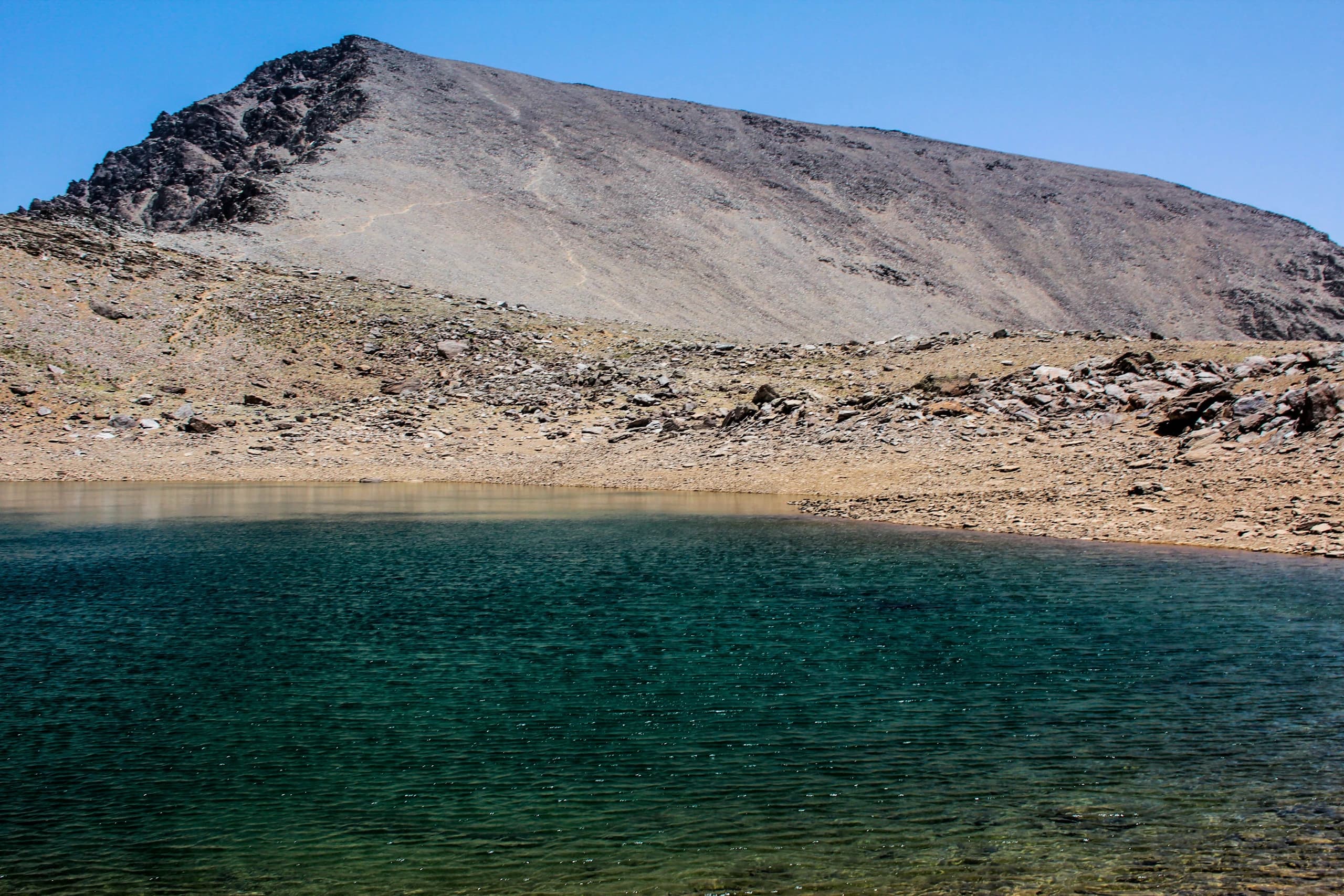
The high mountain landscape alternates between open ridges, scree slopes, ravines, and glacial lagoons. On the ascent, you pass through different environments, from the pine forests and pastures of the lower areas to the barren terrain of the higher elevations. With luck, you can observe fauna native to the mountain range, such as the Spanish ibex. High-altitude vegetation is fragile and adapted to very harsh conditions, so it is important to stay on the trails and not step on the "borreguiles" (wet high-mountain meadows) or pick plants.
On clear days, the summit offers wide views of Sierra Nevada, the Andalusian mountain ranges, and the Mediterranean. Under certain visibility conditions, the mountains of North Africa can be distinguished. The panoramic view always depends on the weather and the clarity of the air: it is not something that can be guaranteed on every ascent.
Capileira, one of the access gateways
For those visiting the Mulhacén from the