The Mass of Minerva and Corpus Christi
A tradition of great beauty dating back to medieval times is the so-called Mass of Minerva, which the Corpus Christi Brotherhood celebrates on the third Sunday of every month. For nearly five hundred years, Corpus Christ

A tradition of great beauty dating back to medieval times is the so-called Mass of Minerva, which the Brotherhood of Corpus Christi celebrates on the third Sunday of every month.
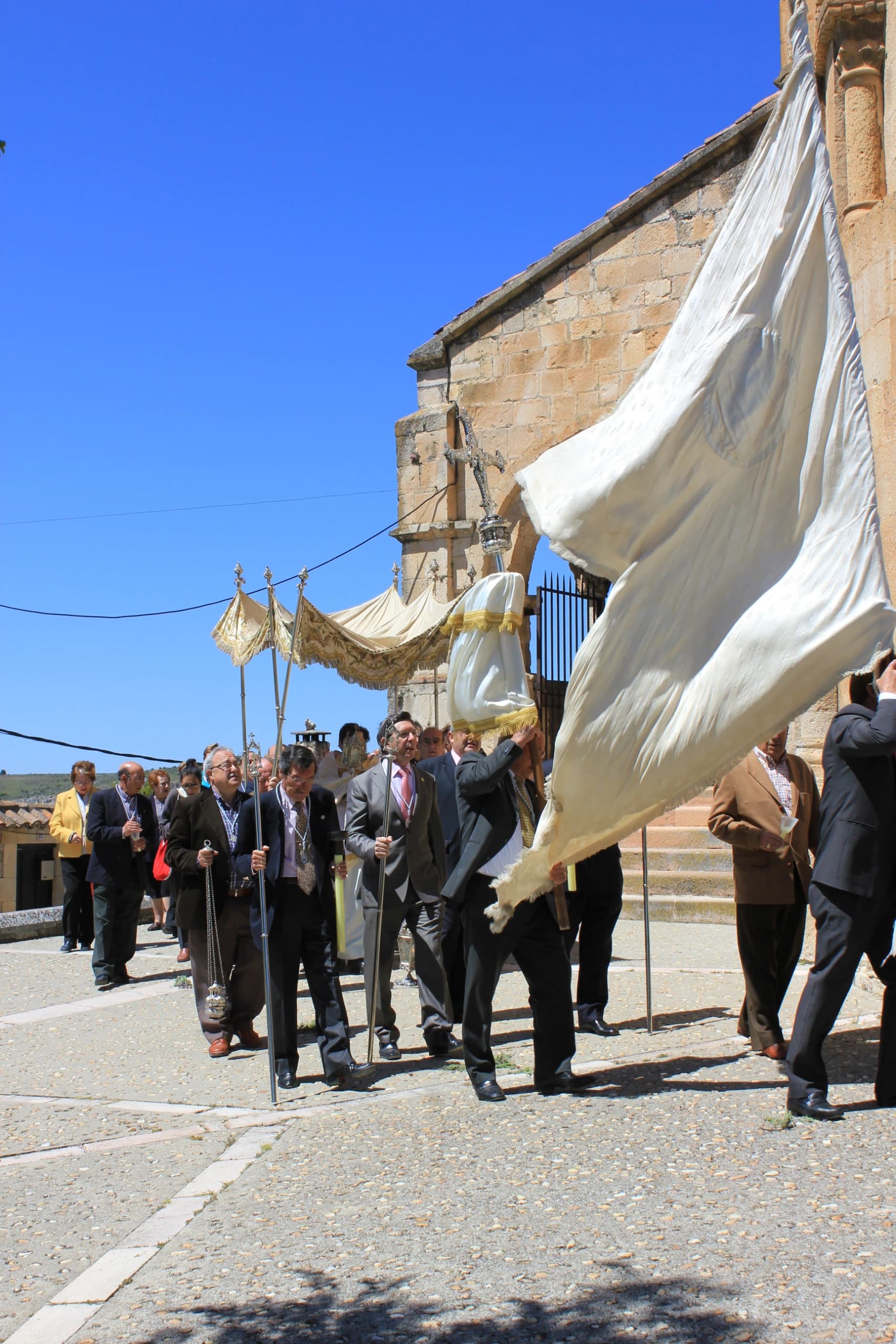
It consists of a Mass at the Church of El Salvador—one of the earliest examples of Segovian Romanesque architecture—followed by a solemn procession in which the Blessed Sacrament is carried under a canopy through the portico to the beat of drums, in a ceremony full of charm and mysticism. The origins of this Mass date back to the 16th century, linked to the era of Luther’s Reformation and the Catholic Counter-Reformation.
In 2005, the Corpus Christi Brotherhood of Sepúlveda began research into the tradition of the Minerva Masses. The result of this work was the National Congress on Minerva Masses, held in Sepúlveda on November 19 and 20 of that same year.
The Minerva Mass takes its name from the Roman church of Santa Maria sopra Minerva, a Christian church built atop a pagan temple dedicated to the Roman goddess of wisdom. In 1539, Pope Paul III approved the Minerva brotherhood, which had been founded by the Dominican Tomás de Stella in that church and was known for its defense of the Eucharist; among its rules was the requirement that members attend, on the third Sunday of each month, a Mass with the exposition of the Blessed Sacrament. Over time, numerous brotherhoods joined the one in Rome, including that of Sepúlveda and others from Segovia, such as the one in Chañe, whose church preserves a papal bull signed by Pope Benedict XIV in 1748 granting the parish permission to join the Roman brotherhood.
For nearly five hundred years, Corpus Christi has been one of the most important feasts of the Catholic Church in the province of Segovia.
A document dated 1607, preserved in the Provincial Historical Archive of Segovia, reveals that on Corpus Christi that year, the church bells roused the people of Segovia at four in the morning, announcing the Mass that was to be celebrated shortly thereafter in the Cathedral, followed by a procession. Although customs have changed over the centuries, traces of those early rites can still be found in the province today. This is the case in Sepúlveda, where every Corpus Christi Sunday, the bells of the Romanesque church of El Salvador begin to ring very early, at 6:45 a.m.
In Sepúlveda, the feast of Corpus Christi is currently celebrated with a ceremony that has been observed since 1539 by the sacramental brotherhoods that joined the one founded at the Church of Santa María Sopra Minerva in Rome, and which does not differ greatly from what was done centuries earlier. However, according to Pedro Carrillo de Huete in the “Crónica del Halconero de Juan II,” processions were already being held in Sepúlveda as early as 1434. On May 21 of that year, King John II, father of Isabella the Catholic, celebrated Corpus Christi in Sepúlveda. The procession in which King John II and his knights participated would have been similar to the one depicted in a painting from the altarpiece of San Miguel (Circle of Juan de la Abadía, 15th century; Diocesan Museum of Lleida). In the painting, one can see the monstrance—similar to the one in Sepúlveda—carried under a canopy by the townspeople dressed in their finest garments, and the clergy wearing embroidered pluvials trimmed with gold braid. They are preceded by a processional cross, just as is still customary in today’s ceremonies.
Sepúlveda would have been adorned with the floral arches that were—and still are—a sign of respect and joy at the presence in its streets of an extraordinary figure, and which served both to welcome the king and for the “Corpus Christi” procession through the streets. We can imagine the procession making its way down the main street that ran in front of the Church of Santiago or the one leading to Santa María.