

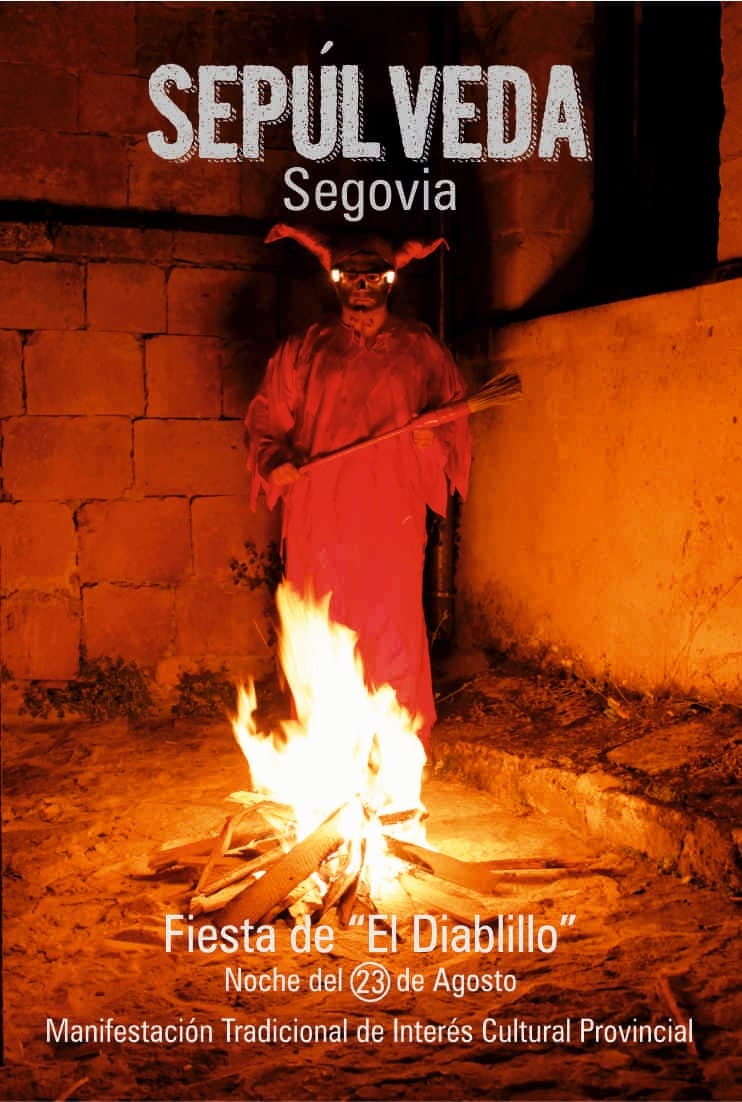
"El Diablillo" Festival
It’s 10 p.m. on any given August 23. The San Bartolomé neighborhood and the Plaza de España in Sepúlveda are pitch-black. A crowd gathers around the Church of San Bartolomé, which celebrates its feast day the following d

The San Bartolomé neighborhood and Sepúlveda’s Plaza de España remain in darkness. A crowd gathers around the Church of San Bartolomé, which celebrates its feast day the following day, August 24.
The Ritual
10:00 p.m. on any August 23. The San Bartolomé neighborhood and Plaza de España in Sepúlveda remain in darkness. A crowd gathers around the Church of San Bartolomé, which celebrates its feast day the following day, August 24. The boisterous crowd, mostly young people, calls for the arrival of the ritual’s main characters. It’s time for El Diablillo.
In reality, there isn’t just one “diablillo.” There are six or seven of them, taking turns in their mission. They are unmistakable figures. They are dressed in red, carry brooms, and have small lanterns attached to both sides of their heads to light their way through the crowd. Each little devil is accompanied by two escorts, or “junior little devils,” dressed in street clothes or black, but also carrying brooms.
Finally, the most eagerly awaited moment arrives. Right on time for its annual appearance, the little devil emerges from behind a large bonfire (lit a short while earlier) and appears at the top of the San Bartolomé staircase. From the Plaza de España, the crowd sees him, as well as his two escorts, positioned to the right and left. They descend swiftly, zigzagging down 26 steps, until they face the onlookers. Broomstroke after broomstroke, the crowd tries to dodge the blows. Chaotic, aimless dashes and revelry—lots of revelry. The whole town of Sepúlveda celebrates San Bartolomé. The “de los Toros” festivities (the last weekend in August) are already here, and the little devil marks the start of the revelry.
Once the ritual concludes, the streetlights are turned back on, and that’s when free lemonade begins to be handed out to all attendees, courtesy of the neighborhood residents, accompanied by the music of a brass band until late into the night.
The Origin
Texts about Saint Bartholomew recount that, while preaching in India, the apostle was summoned by Polymius, a powerful king, who had a daughter possessed by a demon. Once at court, the saint saw that the sick girl was bound in chains because she would bite anyone who approached her. Saint Bartholomew then ordered that the princess be freed from her bonds. The king’s servants did not dare to untie her, but the saint insisted: “Do as I command; do not be afraid; she will not bite you, for I have already bound the demon that possesses her.” The servants untied the young woman, and at that very moment, she was completely healed.
The Tradition
A popular belief in Sepulveda holds that there is one night a year—August 23—when the apostle releases the devil from the chains that bind him, giving rise to the ritual of “Los Diablillos,” which lasts for quite some time, until, around 10:30 p.m., a final run by all the little devils together brings the event to a close. The little devils then return up to the Church of San Bartolomé because it is believed “that the saint ties them up again.”
Antiquity and Evolution
The origins of the El Diablillo festival are lost in the mists of time. In Sepúlveda, no one knows for certain when it began, although older residents claim that their grandparents already participated in the ritual. In fact, oral tradition holds that it was never interrupted, not even during the Spanish Civil War (1936–1939). Over the years, the festival has evolved. For instance, the chains that the little devil wore on his ankles were phased out, and the number of little devils gradually increased. Despite these changes, and according to oral tradition, the ritual has remained true to its essence. Thus, the little devil has gone out at night, trying to scare the children, only to return to the church shortly afterward.
In 2008, the little devils’ costumes were redesigned. The new attire was designed by the multifaceted artist Manuel Gómez Zía, a muralist, sculptor, and illustrator.
In his design for the little devil’s costume, Gómez Zía intended it to be a “continuation of the flames of hell.” In that sense, the artist wanted the viewer to see