

Consitory House (EN)

The stately Town Hall of Rubielos de Mora is one of the town’s most iconic architectural landmarks and has been designated a Site of Cultural Interest since 1983. It is one of the most monumental Renaissance civil buildings within the town’s Historic-Artistic District. The building was constructed as a market hall where local products (agricultural goods, wool, and textiles) were traded. The upper part of the building housed the granary or silo, which now serves as the Town Hall.
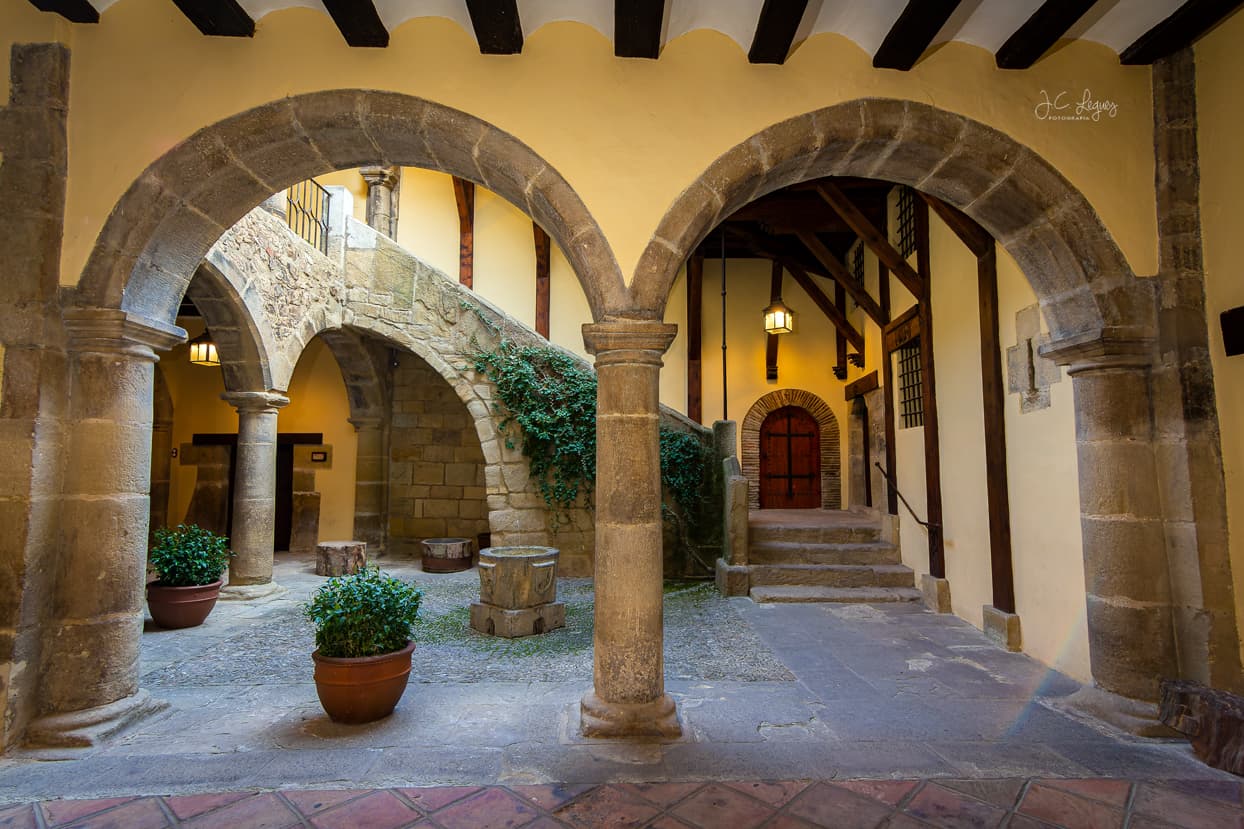
INTERIOR COURTYARD
The contract for its construction was signed in 1523, with the work commissioned to Pedro de la Hoya from Biscay, and it was completed in 1571. The building was constructed using masonry combined with ashlar stone at the corners, doors, windows, and main façade. It features a rectangular floor plan and two stories. The ground floor is notable for an open market hall, supported by semicircular arches, which occupies two of the four bays. In the remaining two bays is an original staircase from 1630 leading to the main floor, where the municipal offices and the ensemble of the anteroom and Session Hall are located.
The small prison cell on display was intended for public viewing; those who committed a crime were locked up here so that everyone could see them, as this was a form of humiliation at the time, much like having to crouch to enter through this very low door. They were then transferred to the old prison to await sentencing, which was located in the former castle in the Barrio del Campanar neighborhood. The grille belonged to the Convent of the Augustinian Nuns.
PEDRO IV
In the courtyard, remnants of the original cobblestones remain around the fountain and at the entrance, where the sculpture of Pedro IV stands, the work of Rubielos-born sculptor José Gonzalvo. Pedro IV was an Aragonese king famous for his resistance against Castilian troops, who granted Rubielos the title of town in 1366 as a reward for its resistance against Castilian forces. This meant that its inhabitants did not have to pay taxes for a long period of time, which led to the settlement of so many nobles. Additionally, they benefited from the town being walled, ensuring their property remained protected. These nobles came from Navarre, Catalonia, and the Basque Country, where they built their palatial homes and controlled a thriving trade. This is why the town of Rubielos came to be known as “La Corte de la Sierra.”